1. Overview
2. Scientific Working Packages WP
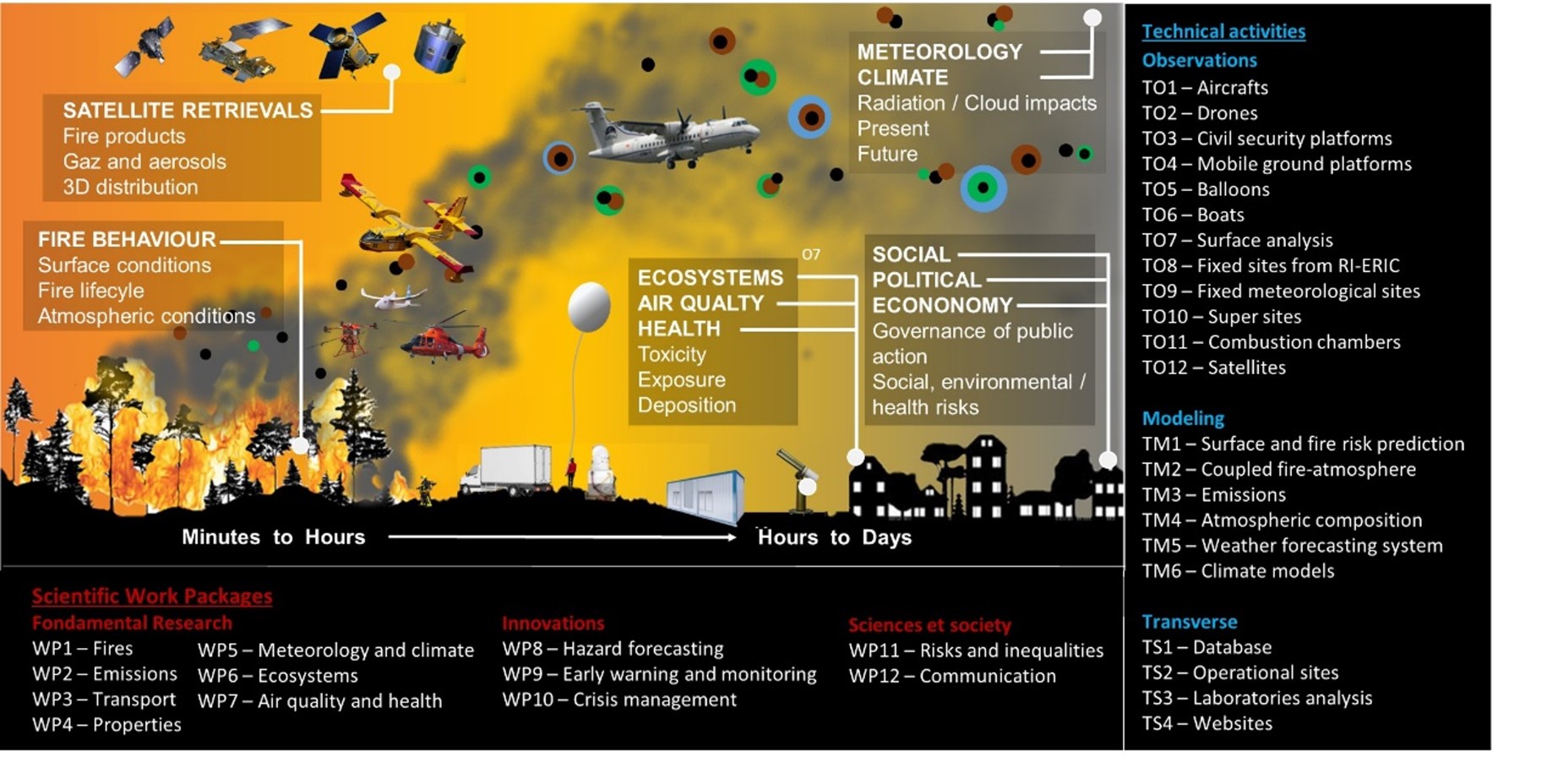
The Scientific Committee is structured around the 12 main scientific objectives of EUBURN, each addressed by a dedicated Scientific Working Packages (WP). These objectives stem from the different EUBURN projects; therefore, their numbering does not necessarily correspond to that used within individual projects. They will continue to evolve over time as the partnership and projects develop. The first six Working Packages (WP1 to WP6) focus on fundamental research and cover the full chain of interactions and feedbacks between the land surface, fire, gas and aerosol emissions, and their effects on weather and climate change (radiation, clouds, storms and precipitation), ecosystems, air quality, and health. The following five Working Packages (WP7 to WP11) build on the fundamental research conducted in the six seven groups to develop operational observation and modelling tools. These tools aim to support decision-making for wildfire and vegetation fire risk management, provide complementary hazard indicators, and address specific needs in climate research. The final Working Packages (WP12) aims to ensure that the programme’s results are shared internationally within the scientific community and communicated in an appropriate manner to the general public, operational centres, and policy-makers, in order to promote science-based decision-making
Fondamental Research
- WP1 – Fires: Understanding the biological and physical processes controlling fire ignition, spread, and intensity
- .WP2 – Emissions: Quantifying gas and aerosol emission factors released by fires
- WP3 – Transport: Identifying the factors controlling plume dynamics, including heating induced by absorbing aerosols, turbulence, dispersion, updrafts, pyroconvection, and cloud conditions
- WP4 – Properties: Quantifying the concentrations and properties of fire-emitted gases and aerosols throughout their life cycle.
- WP5 – Meteorology and climate
- WP6 – Ecosystems Aerosol
- WP7 – Air Quality and healt
Innovations
- WP8 – Hazard forecasting
- WP9 – Early warning and monitoring
- WP10 – Crisis management
- WP11 – Impacts: weather, climate, ecosystems, air quality, health
Sciences and society
- WP11 – Risks and inequalities
- WP12 – DCommunication
3. Technical Teams
The implementation of the programme requires the establishment of technical teams responsible for preparing and deploying instrumental platforms or specific modelling tools. Cross-cutting tasks aimed at supporting and coordinating these groups are also necessary. Three types of technical teams will be established:
Observation (TO)
- TO1 – Aircraft
- TO2 – Drones
- TO3 – Civil security platforms
- TO4 – Mobile ground platforms
- TO5 – Balloons
- TO6 – Boats
- TO7 – Surface analysis
- TO8 – Fixed sites from RI-ERIC
- TO9 – Fixed meteorological sites
- TO10 – Super-sites
- TO11 – Combustion chamber
- TO12 – Satellites
Modelling (TM)
- TM1 – Surface and fire risk prediction
- TM2 – Coupled fire–atmosphere
- TM3 – Emissions
- TM4 – Atmospheric composition
- TM5 – Weather forecasting system
- TM6 – Climate models
Transverse (TS)
- TS1 – Databases
- TS2 – Operational sites
- TS3 – Laboratories analysis
- TS4 – Websites
The technical teams are composed of representatives from each partner involved in the technical activities of EUBURN. The role of the technical team coordinators is to:
- Ensure the implementation of each technical activity
- Prepare the reporting documents associated with their technical team
- Monitor progress and report to the Executive Committee on the advancement of technical activities